

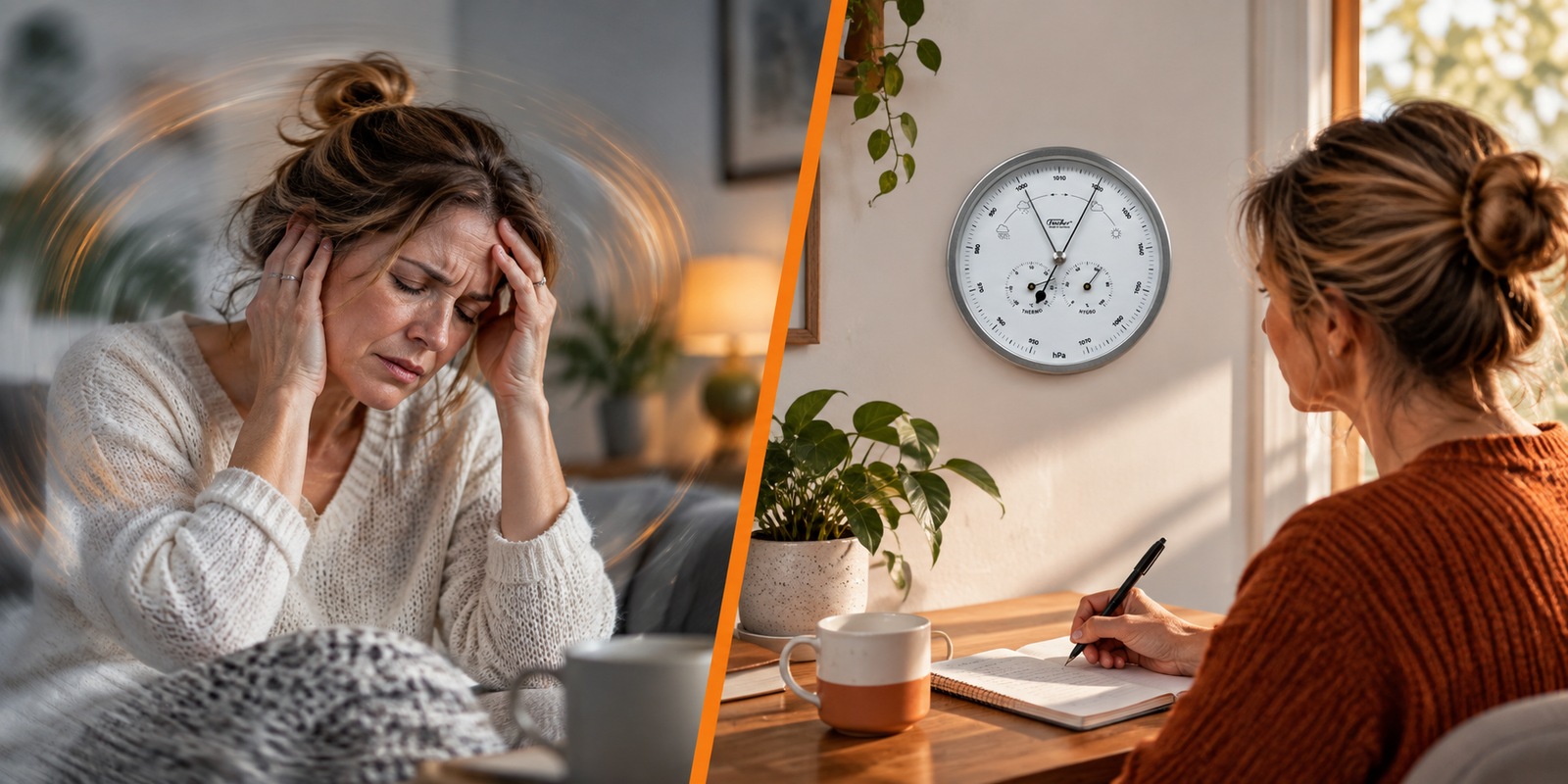

If you live with Meniere’s disease, you may have noticed something strange: your ears sometimes seem to know the weather is changing before you do.
Perhaps the pressure or fullness in your ear increases. Your tinnitus becomes louder. You feel dizzy or a little less steady. Then the weather changes.
So, is there actually a connection between barometric pressure and Meniere’s disease?
Research suggests there may be.
Studies have found associations between atmospheric pressure and Meniere’s symptoms, including vertigo, tinnitus, hearing changes and a feeling of fullness in the ear. It does not mean weather causes every Meniere’s attack, and there is no particular barometric pressure reading that can reliably predict a flare.
But it does give you something useful to pay attention to.
A barometer lets you see atmospheric pressure changing around you, so you can compare those changes with your own symptoms and start learning whether there is a pattern for you.
It won't treat Meniere’s disease. It won't stop an attack.
What it can do is give you another piece of information, and potentially a little more warning that weather conditions associated with your own symptoms are developing.
What Is Meniere’s Disease?
Meniere’s disease is a condition affecting the inner ear, which plays an important role in both hearing and balance.
People with Meniere’s disease can experience symptoms including:
- Vertigo or dizziness
- Tinnitus
- Changes in hearing
- Fullness or pressure in the affected ear
One of the frustrating things about Meniere’s disease is that attacks can be difficult to predict.
You might feel fine one day and very different the next. Researchers have therefore looked at a number of factors that may be associated with Meniere’s symptoms, including changes in atmospheric pressure and other weather conditions.
Can Barometric Pressure Affect Meniere’s Disease?
Research suggests changes in barometric pressure may be associated with Meniere’s symptoms and attacks in some people.
A 2016 study published in PLOS ONE followed 56 people with Meniere’s disease while researchers compared recorded vertigo episodes with local weather conditions. Changes in atmospheric pressure were significantly associated with the onset of Meniere’s episodes.
The researchers concluded that air pressure changes may potentially have value as an early warning indicator for some people with Meniere’s disease, although they did not suggest that pressure could reliably predict every attack.
A larger UK study involving 397 people with consultant-diagnosed Meniere’s disease also found a relationship between atmospheric pressure and symptoms. Symptom severity and the prevalence of attacks were lower on days when atmospheric pressure was higher. When pressure was below 1013 hPa, the risk of an attack in that study was around 30% higher.
A 2023 study published in Auris Nasus Larynx also found significant correlations between atmospheric pressure, temperature and the onset of Meniere’s attacks.
So if you have found yourself saying, “My ears always seem worse when the weather changes,” there is research suggesting there may be a connection worth paying attention to.
But there is an important point to understand.
There isn't one pressure reading that affects everyone.
What Is Barometric Pressure?
Barometric pressure, also called atmospheric pressure, is essentially the pressure created by the weight of the air around us.
A barometer measures barometric pressure, usually in hectopascals or hPa.
Average atmospheric pressure at sea level is approximately 1013 hPa, but pressure is constantly changing as weather systems move through.
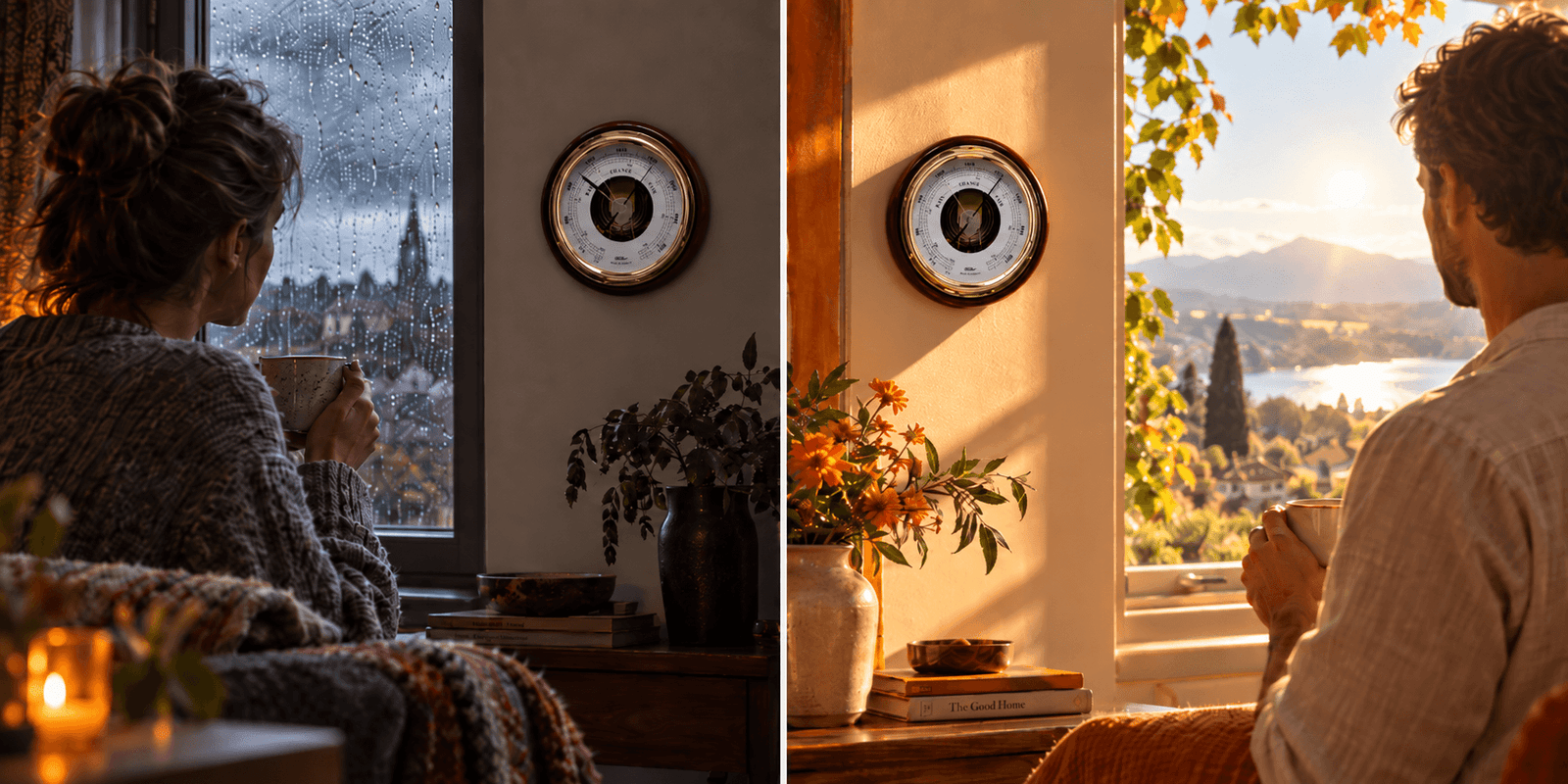
A falling barometer can often accompany approaching unsettled weather, while rising pressure can indicate improving or more stable conditions.
For someone with Meniere’s disease, however, what may be particularly interesting isn't simply the number on the dial.
It is how that pressure is changing.
For example:
1019 hPa → 1015 hPa → 1010 hPa
The atmosphere around you is changing.
The useful question is: do your symptoms change with it?
Does Low Barometric Pressure Make Meniere’s Disease Worse?
It's About Patterns, Not One Particular Number
It may for some people, but low barometric pressure should not be treated as a universal Meniere’s trigger.
The UK longitudinal study found that when atmospheric pressure was below 1013 hPa, the risk of a Meniere’s attack was approximately 30% higher in the group studied.
However, other research has found relationships with changes in pressure, rather than simply whether the pressure is high or low. For example, the PLOS ONE study found that changes in air pressure were significantly associated with the onset of episodes.
That is why we would not recommend looking at your barometer and thinking:
“It's below 1013 hPa, so I'm going to have an attack.”
That's not what the research tells us.
Meniere’s disease is more complicated than one number on a dial.
Instead, a barometer gives you the opportunity to watch what is happening with atmospheric pressure and compare it with what happens to your ears.
Your pattern might involve lower pressure. It might be a rapid change in pressure. It may involve another weather condition as well. Or you may discover that atmospheric pressure makes very little difference to you.
That's why tracking your own pattern can be more useful than looking for one supposed Meniere’s pressure number.
Can Changes in Barometric Pressure Cause Dizziness?
Changes in atmospheric pressure have been investigated as a possible factor in conditions involving dizziness and the inner ear.
For people with Meniere’s disease specifically, research has found an association between atmospheric pressure and vertigo episodes. In the 2016 repeated-measures study, changes in air pressure were significantly associated with the onset of Meniere’s vertigo episodes.
That does not mean every episode of dizziness during changing weather is caused by barometric pressure. Dizziness and vertigo can have many causes.
If you already have diagnosed Meniere’s disease and have repeatedly noticed dizziness appearing around weather changes, however, tracking atmospheric pressure may help you see whether there is a consistent pattern.
Can a Barometer Predict a Meniere’s Attack?
No, not reliably.
And we think it is important to be clear about that.
A barometer is a weather instrument. It measures atmospheric pressure. It isn't a medical device and cannot tell you that a Meniere’s attack is definitely coming.
What it can do is show you when atmospheric pressure is changing.
That becomes much more useful if you discover that certain pressure changes repeatedly coincide with changes in your symptoms.
For example, perhaps you begin to notice that your tinnitus becomes louder, your ear starts feeling full or you become more prone to dizziness when atmospheric pressure changes significantly.
If you see a similar pattern repeatedly over time, looking at your barometer may give you a useful heads-up that the weather conditions you associate with a flare are developing.
Not a prediction. A heads-up.
And when Meniere’s disease can sometimes feel frustratingly unpredictable, knowing more about the conditions surrounding your own symptoms may help you feel a little more prepared.
How Can You Track Barometric Pressure and Meniere’s Symptoms?
The easiest way is to keep it simple. Here is a A Simple Experiment You Can Try at Home
You need:
- A barometer
- A notebook, diary or notes app
- A minute or two each day
1. Record the barometric pressure
Write down the current pressure in hPa.
2. Record which way the pressure is moving
Is it rising, falling or staying reasonably steady?
A traditional analogue barometer makes this particularly easy because you can use the marker hand to mark a previous reading and see whether pressure has moved when you check it again.
3. Record your Meniere’s symptoms
Make a quick note of anything you notice, such as:
- Ear pressure or fullness
- Tinnitus
- Changes in hearing
- Dizziness
- Vertigo
4. Record the weather
Note anything obvious, such as rain, storms, unusually hot weather, humidity or a sudden change in conditions.
Keep doing this for several weeks or, even better, a few months.
You are looking for repeated patterns, not one particular day.
What Might a Meniere’s Weather Diary Look Like?
| Day | Barometric Pressure | Pressure Trend | Symptoms |
|---|---|---|---|
| Monday | 1019 hPa | Stable | Feeling well |
| Tuesday | 1015 hPa | Falling | Slight ear fullness |
| Wednesday | 1009 hPa | Falling | Tinnitus louder |
| Thursday | 1007 hPa | Stable | Dizziness |
| Friday | 1013 hPa | Rising | Feeling better |
One sequence like this does not prove atmospheric pressure caused your symptoms.
But if you begin seeing similar patterns again and again across different weather systems, you have learned something useful about your own experience of Meniere’s disease.
You can also take those observations with you when discussing your symptoms with your doctor or ENT specialist.
How Can Knowing the Barometric Pressure Help You Prepare?
You can't change the weather.
But you can know when it is changing.
If, over time, you discover that particular changes in atmospheric pressure regularly coincide with your Meniere’s symptoms, watching your barometer could give you a little more opportunity to prepare.
What preparing looks like will be different for everyone and should follow any advice you have received from your healthcare professional.
It might simply mean being more aware of how you're feeling, reconsidering plans if necessary, avoiding situations where sudden vertigo would be particularly difficult, or making sure you have the things you normally need if your symptoms appear.
The barometer isn't treating the problem.
It's helping take some of the surprise out of it.
Why Use a Barometer Instead of a Weather App?
Of course, you can look up atmospheric pressure online.
But there is something refreshingly simple about having a proper barometer on the wall.
You walk past it and look.
No app to open. No notification to remember. No need to search for the pressure amongst a dozen other weather readings.
A traditional mechanical barometer is continuously responding to atmospheric pressure around it. You can mark the previous reading, come back later and immediately see whether the pressure has risen or fallen.
If your goal is to start noticing relationships between weather changes and Meniere’s symptoms, that makes checking pressure an easy habit to build.
If barometric pressure is new to you, our guide explains what barometric pressure is and how a barometer works.
Once you have your instrument, you can also follow our guide on how to set up your barometer correctly.
What Type of Barometer Should You Use?
You don't need an elaborate digital weather system simply to keep an eye on atmospheric pressure.
A good quality analogue barometer gives you the pressure reading you need and makes it easy to see whether pressure is rising or falling.
At Barometers & Clocks, our barometer collection includes precision instruments from specialist manufacturers including Fischer Germany and Barigo.
They are proper weather instruments, made to be useful and made to last.
They also look considerably better hanging on the wall than most plastic digital weather gadgets.
If you would also like to keep an eye on temperature and humidity, take a look at our weather stations. Many combine a barometer, thermometer and hygrometer in one instrument, allowing you to watch several weather conditions together.
You can also read our guide to what a hygrometer is and how it measures humidity.
Is Low Pressure the Only Thing That Matters?
Probably not.
Weather is complicated, and atmospheric pressure isn't the only environmental variable researchers have investigated.
Temperature, humidity and other weather conditions may also play a role.
One study, for example, found associations between Ménière’s symptoms and both atmospheric pressure and humidity.
This is another reason why keeping your own records can be useful.
Rather than looking for a single number that supposedly triggers an attack, you can begin to understand the combination of weather changes and symptoms that you personally experience.
Could a Barometer Predict a Ménière’s Attack?
Not reliably—and this is where we need to be careful.
Research into the relationship between atmospheric pressure and Ménière’s disease is interesting, but it is not yet accurate enough to say that a particular barometer reading will predict an attack.
Some research has suggested that pressure changes could potentially provide an early warning for some people, but more research is needed.
Ménière’s disease can also be influenced by many other factors.
So think of a barometer as another piece of information, rather than an early-warning alarm.
It may help you answer a question such as:
"Does my Ménière’s seem to be worse when atmospheric pressure changes?"
That is something you can investigate for yourself.
Does Hot Weather Affect Meniere’s Disease?
Temperature has also been investigated alongside atmospheric pressure.
A 2023 study examining Meniere’s attacks and meteorological conditions found significant correlations with both atmospheric pressure and temperature in the population studied.
That does not mean hot weather automatically triggers Meniere’s symptoms.
Weather conditions do not occur in isolation. Temperature and atmospheric pressure can change together, and individuals may respond differently.
If you suspect hot weather affects your symptoms, it may be useful to record temperature alongside atmospheric pressure and how you feel.
A weather station can be useful if you want to monitor pressure, temperature and humidity together.
What Is the Best Climate for Meniere’s Disease?
There is no single climate proven to be best for everyone with Meniere’s disease.
Research has found associations between Meniere’s symptoms and weather variables including atmospheric pressure, temperature and, in some studies, humidity. But that does not mean everybody responds to those conditions in the same way.
For one person, rapidly changing pressure may appear important. For another, lower pressure or hot conditions may seem more noticeable. Someone else may see no obvious weather pattern at all.
Rather than searching for the perfect Meniere’s climate, it may be more useful to understand how your symptoms respond to the weather where you actually live.
Frequently Asked Questions About Barometric Pressure and Meniere’s Disease
Can barometric pressure affect Meniere’s disease?
Research has found associations between atmospheric pressure and Meniere’s symptoms and attacks in some people. This does not mean barometric pressure affects everybody with Meniere’s disease or causes every attack. Studies have investigated both lower atmospheric pressure and changes in pressure.
What barometric pressure causes Meniere’s symptoms?
There is no single barometric pressure known to cause Meniere’s symptoms in everyone. One UK study found the risk of an attack was around 30% higher when pressure was below 1013 hPa, but 1013 hPa should not be treated as a universal trigger point. Tracking changes and comparing them with your own symptoms is more useful than relying on one number.
Does low barometric pressure make Meniere’s disease worse?
Some research has found more Meniere’s attacks or greater symptom severity during lower atmospheric pressure. Other research has found an association with changes in pressure. Individual responses vary.
Can falling barometric pressure cause vertigo?
Atmospheric pressure changes have been associated with vertigo episodes in people with Meniere’s disease, but vertigo and dizziness can have many causes. A barometer cannot tell you what is causing an individual episode.
How do you treat barometric pressure dizziness?
There is no universal treatment for “barometric pressure dizziness” because dizziness can have many different causes. If you have Meniere’s disease, follow the treatment and management advice provided by your doctor or specialist. Tracking atmospheric pressure may help you recognise patterns and prepare for conditions that have previously coincided with your symptoms, but a barometer itself is not a treatment.
Can a barometer warn you about a Meniere’s flare?
Not reliably and this is where we need to be careful. Research into the relationship between atmospheric pressure and Ménière’s disease is interesting, but it is not yet accurate enough to say that a particular barometer reading will predict an attack. Some research has suggested that pressure changes could potentially provide an early warning for some people, but more research is needed. Ménière’s disease can also be influenced by many other factors. So think of a barometer as another piece of information, rather than an early-warning alarm. It may help you answer a question such as: "Does my Ménière’s seem to be worse when atmospheric pressure changes?"That is something you can investigate for yourself.
Should I track rising or falling barometric pressure?
Track both. Research does not show one universal pressure pattern for everyone with Meniere’s disease. Record the current pressure, whether it is rising or falling, and your symptoms. Over time, you can look for your own repeated patterns.
Know What's Happening With the Weather Around You
One of the most frustrating things about Meniere’s disease can be not knowing when your symptoms are going to change.
A barometer can't remove that uncertainty completely.
But it does let you see atmospheric pressure changing around you.
If weather is one of the factors associated with changes in your ears, monitoring pressure may help you recognise your own patterns and give you a little more opportunity to prepare.
No magic number. No promise that a flare is coming.
Just a proper weather instrument showing you what the atmosphere around you is doing.
Important health information: This article is provided for general information only and is not intended to diagnose, treat or prevent Meniere’s disease. A barometer measures atmospheric pressure. It is not a medical device and cannot predict whether or when a Meniere’s attack will occur. Research suggests associations between atmospheric pressure and Meniere’s symptoms, but individual experiences vary. If you have new symptoms, severe dizziness or vertigo, or your existing symptoms are changing or worsening, speak with your doctor or an appropriately qualified healthcare professional.



Leave a comment (all fields required)