



Quick answer: Barometric pressure, also called atmospheric pressure or air pressure, is the pressure created by the weight of the atmosphere around us. A barometer measures that pressure. Rising pressure often points towards more settled weather, while falling pressure can indicate wetter, windier or more changeable weather is on the way.
Weather forecasting can now involve satellites, supercomputers, radar maps and enough colourful graphics to make a television news studio look like mission control.
And yet one of the most useful clues about what the weather is doing can still be found inside a beautifully simple mechanical instrument hanging on your wall.
The barometer.
It does not need Wi-Fi. It does not need charging. It will not suddenly announce that an essential software update is required while a storm is rolling over the horizon.
It simply measures the air around you.
And once you understand what barometric pressure means, that little needle becomes surprisingly informative.
What Is Barometric Pressure?
Barometric pressure is the pressure exerted by the atmosphere on the Earth's surface. It is also called atmospheric pressure or air pressure.
Think of the atmosphere as an enormous ocean of air surrounding the planet.
You cannot see it, which makes it very easy to forget that it is there. But air has mass, gravity pulls it towards Earth, and all of that air above you creates pressure.
That is atmospheric pressure.
And because the instrument traditionally used to measure it is called a barometer, we also call it barometric pressure.
The interesting part is that this pressure is not constant.
It changes as weather systems move, temperatures change and air masses shift around the planet. Those changes give us valuable clues about what the atmosphere is doing and, more importantly, what it may be about to do next.
What Does Barometric Pressure Tell You?
Barometric pressure helps you understand whether the atmosphere around you is becoming more or less settled.
In very broad terms:
- Rising pressure often indicates more settled weather is developing.
- Falling pressure often indicates more unsettled weather is approaching.
- Rapidly changing pressure tells you the atmosphere is changing quickly.
- Steady pressure suggests the existing weather pattern may continue for a while.
This is why watching the trend is usually more useful than staring at one isolated pressure reading and expecting it to reveal the future like a crystal ball.
A barometer is clever.
It is not magic.
What Does Rising Barometric Pressure Mean?
Rising barometric pressure generally suggests that a higher-pressure weather system is developing or approaching.
High-pressure systems are often associated with more stable atmospheric conditions, which can mean clearer skies, lighter winds and drier weather.
The key word here is generally.
The atmosphere has several billion moving parts and has never shown the slightest interest in making weekend plans convenient.
But if your barometer has been climbing steadily for several hours, it is usually a sign that conditions are becoming more settled.
What Does Falling Barometric Pressure Mean?
Falling barometric pressure usually means that a lower-pressure weather system is approaching or developing.
Lower-pressure systems are commonly associated with cloud, rain, stronger winds and more changeable weather.
A gradual fall tells you things are changing.
A rapid fall tells you they may be changing rather enthusiastically.
This is one reason barometers have been used by sailors for generations. Discovering that atmospheric pressure is dropping before conditions deteriorate is considerably more useful than discovering it when your hat has already disappeared over the side of the boat.
What Is High Barometric Pressure?
This sounds like a question that ought to have a wonderfully simple numerical answer.
It does not.
There is no single barometric pressure reading that automatically counts as "high pressure".
A high-pressure system is an area where atmospheric pressure is higher than the pressure surrounding it.
Likewise, a low-pressure system is an area where pressure is lower than the surrounding atmosphere.
The Australian Bureau of Meteorology explains that highs and lows are defined relative to the surrounding pressure, rather than by one magic number.
This matters because people often see 1013 hPa mentioned online and assume:
Above 1013 = good.
Below 1013 = bad.
Unfortunately, the atmosphere has refused to cooperate with this beautifully simple system.
1013.25 hPa is standard atmospheric pressure at sea level. It is a useful reference value, not a switch that turns sunshine on and rain off.
What Is Low Barometric Pressure?
Low barometric pressure means the pressure in an area is lower than the pressure surrounding it.
Air tends to rise in lower-pressure systems. As it rises and cools, moisture can condense and contribute to cloud formation and precipitation.
This is why low-pressure systems are commonly associated with more unsettled weather.
But again, the important thing is the weather system and the pressure trend around you, not simply whether your instrument happens to read a number below 1013.
What Is Normal Barometric Pressure?
Standard atmospheric pressure at sea level is 1013.25 hectopascals (hPa).
You may also see this written as:
| Measurement | Standard sea-level pressure |
|---|---|
| Hectopascals | 1013.25 hPa |
| Millibars | 1013.25 mb |
| Inches of mercury | 29.92 inHg |
| Millimetres of mercury | Approximately 760 mmHg |
This does not mean your barometer should permanently sit at 1013.25 hPa.
If it did, weather watching would become spectacularly boring.
Pressure naturally rises and falls as weather systems pass through.
What Is Barometric Pressure Measured In?
In Australia and New Zealand, atmospheric pressure is normally reported in hectopascals, abbreviated hPa.
You may also see:
- Millibars (mb)
- Inches of mercury (inHg)
- Millimetres of mercury (mmHg)
Conveniently, one hectopascal is numerically equal to one millibar.
So 1020 hPa and 1020 mb are the same pressure.
Some traditional barometers show more than one scale, particularly instruments designed for international markets.
How Is Barometric Pressure Measured?
Barometric pressure is measured using an instrument called a barometer.
There are several types, including mercury barometers and aneroid barometers.
For a home, office or boat, you will most commonly come across an aneroid barometer.
And despite the rather Victorian-sounding name, the principle is wonderfully neat.
Inside an aneroid barometer is a sealed flexible metal capsule. When atmospheric pressure changes, that capsule expands or contracts slightly.
A mechanical linkage magnifies the movement and transfers it to the needle on the dial.
So when you look at an analogue barometer, you are not looking at a computer's interpretation of atmospheric pressure.
You are watching atmospheric pressure physically move a mechanism.
Which is rather satisfying in a world where your refrigerator apparently now needs an internet connection.
What instrument measures barometric pressure?
A barometer measures barometric or atmospheric pressure. Most quality mechanical home barometers are aneroid barometers, which use changes in a sealed metal capsule to move the needle on the dial.
How Do You Read Barometric Pressure?
The first mistake people make with a barometer is looking only at the number.
The second is staring at the words printed around the dial and assuming the weather must immediately obey them.
It will not.
The most useful information is usually which direction the pressure is moving and how quickly it is moving.
| Barometer trend | What it can indicate |
|---|---|
| Rising steadily | Weather becoming more settled |
| Falling steadily | More unsettled weather may be approaching |
| Falling quickly | A significant or rapidly developing weather change may be occurring |
| Relatively steady | The existing weather pattern may continue |
A barometer should therefore be read as a trend instrument, not simply a dial displaying one number.
How Do You Track Barometric Pressure Changes?
This is where owning an analogue barometer becomes genuinely useful.
Many traditional barometers have two pointers.
One is connected to the barometer mechanism and shows the current atmospheric pressure.
The other is a marker pointer that you move yourself.
Set the marker over the current pressure needle. Come back a few hours later and compare the two.
- If the measuring needle is now above your marker, pressure has risen.
- If it is below your marker, pressure has fallen.
- If it has barely moved, conditions are relatively stable.
That is it.
No spreadsheet. No meteorology degree. No subscription.
Do this regularly and you start recognising the relationship between pressure changes and the weather around your own home.
After a while, checking the barometer becomes rather like looking out the window, except the barometer is telling you what the atmosphere is doing rather than merely confirming that it is currently raining.
How Do You Use Barometric Pressure to Predict the Weather?
A barometer gives you one of the most useful pieces of information in home weather forecasting: the pressure trend.
Suppose it is currently sunny.
If pressure has been falling steadily all morning, the blue sky outside may not tell the whole story. Conditions may be becoming less stable even though nothing dramatic has happened yet.
Conversely, it may still be raining while the barometer is beginning to rise. That can indicate the weather system responsible is starting to move away and conditions may improve.
This is the fascinating bit.
A barometer lets you look beyond what the weather is doing now and start thinking about what direction it is heading.
At What Barometric Pressure Does It Rain?
There is no single barometric pressure at which rain automatically begins.
Rain depends on far more than one pressure reading. Moisture, temperature, fronts, wind, topography and the wider weather system all matter.
Lower and falling pressure is often associated with wetter, more unsettled conditions, but you cannot look at a dial reading and say, for example, "Right, it has reached 1005 hPa, release the rain."
Nature is irritatingly more complicated than that.
Again, watch the trend.
Why Does Altitude Affect Barometric Pressure?
Atmospheric pressure decreases as altitude increases.
At higher elevations there is less atmosphere above you, which means less air pressing down.
This creates an obvious problem.
If a weather station near sea level and another station high in the mountains simply reported their raw pressure readings, comparing the two would not tell you very much about the weather systems moving between them.
This is why meteorological pressure is commonly adjusted to mean sea-level pressure, allowing readings from different elevations to be compared properly.
It is also why your home barometer needs to be correctly set for your location when you first receive it.
How Do I Measure Barometric Pressure at Home?
The simplest answer is: buy a barometer.
Preferably a good one.
Once your barometer arrives, compare it with the current sea-level atmospheric pressure reported for your local area and make the small calibration adjustment described in the instructions.
Once calibrated, you generally leave it alone and let it do its job.
You can then:
- Check whether pressure is rising or falling
- Track pressure changes during the day
- Compare pressure trends with local weather
- Recognise approaching changes in conditions
- Build an understanding of weather patterns around your own home
If you are setting up a new instrument, read our guide to setting up and calibrating a barometer.

Fischer 1602-01 Weather Station, combining a barometer, hygrometer and thermometer in one German-made instrument.
What Is the Barometric Pressure Today?
There is no single answer to "what is the barometric pressure today?" because atmospheric pressure changes by location and weather system.
The pressure in Sydney can be different from Melbourne. Melbourne can be different from Perth. And a pressure system moving across the country can change your own reading considerably within a day.
For the current barometric pressure in your area, check the latest local observations from the Bureau of Meteorology.
Then look at your own barometer.
The current number is useful.
Whether it is rising or falling is usually more interesting.
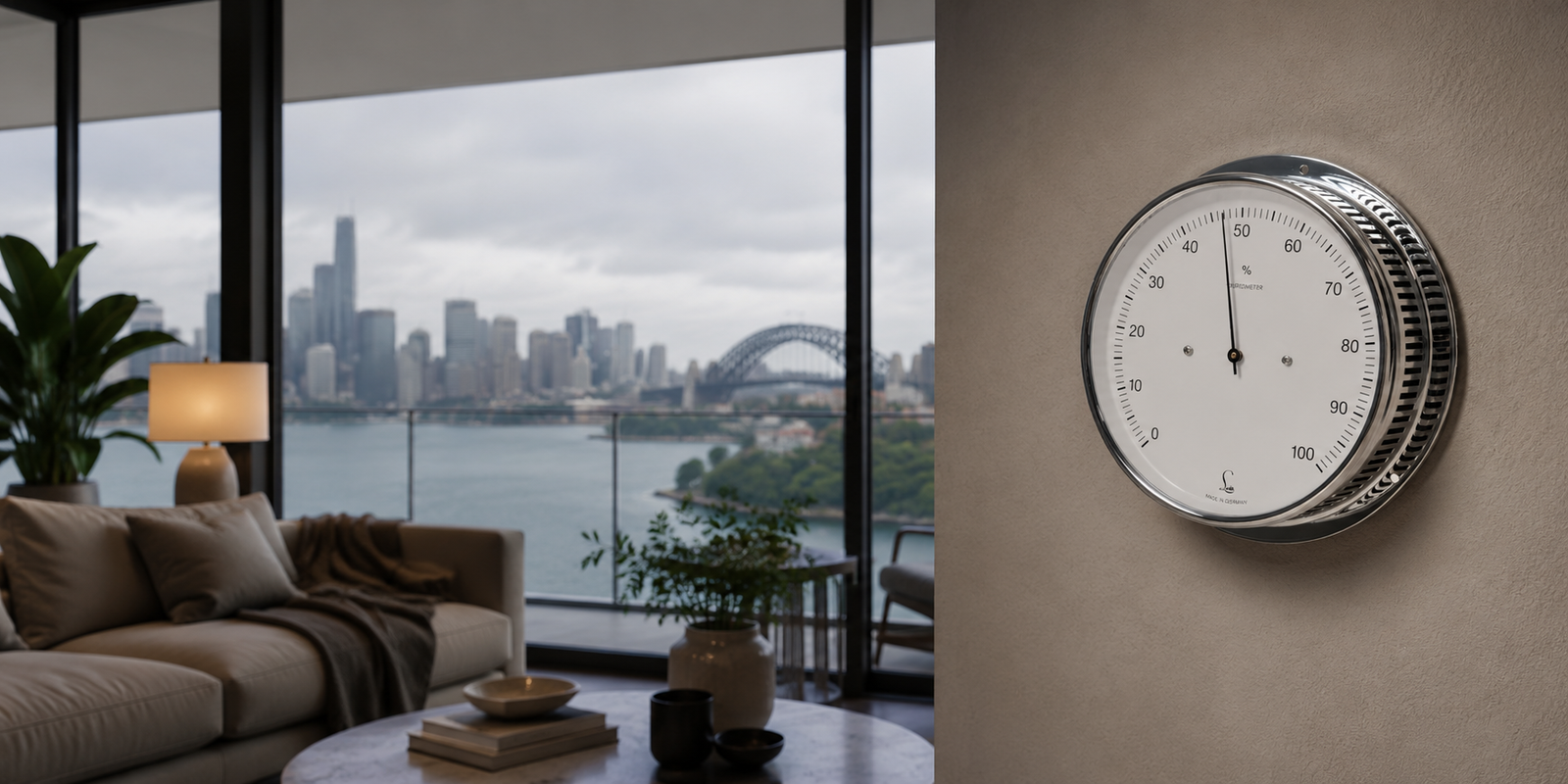
Barometer or Home Weather Station?
If you primarily want to understand atmospheric pressure and changing weather patterns, a standalone barometer is an excellent choice.
If you want a broader view of conditions around your home, choose a weather station.
A traditional three-in-one weather station combines:
- Barometer: atmospheric pressure and weather trends
- Hygrometer: relative humidity
- Thermometer: temperature
Together, the three instruments give you considerably more context than temperature alone.
You can see whether it is hot, whether the air is humid, and whether atmospheric pressure is beginning to change.
Which is considerably more useful than opening the back door, squinting suspiciously at a cloud and declaring that it "looks like rain".
If you are deciding between different types, read our guide to the best home weather stations in Australia.
Which Barometer Should I Choose?
If you simply want a proper barometer that is easy to read and looks good on the wall, a standalone analogue instrument is hard to beat.
Our Fischer Popular Ash & Chrome 170mm Barometer is handmade in Germany and gives you a large, clear pressure dial without filling your wall with unnecessary gadgets.
If you want temperature and humidity as well, the Fischer 1602-01 Weather Station combines a barometer, hygrometer and thermometer in one modern stainless steel instrument.
Want Barometric Pressure Only?
Choose a standalone barometer. Simple, beautifully made and extremely easy to read.
Want the Full Weather Picture?
Choose a weather station combining pressure, temperature and humidity.
Why Use a Barometer When You Already Have a Weather App?
Because they do different things.
A weather app gives you a forecast built from weather stations, radar, satellite observations and forecasting models across a much wider area.
A barometer measures the atmospheric pressure where the instrument is.
One gives you a forecast.
The other gives you a physical measurement.
We would use both.
The app tells you what meteorologists think the wider weather system will do.
The barometer lets you watch that system arrive.
And, frankly, a beautifully made brass, timber or stainless steel instrument looks rather better hanging on the wall than an ageing tablet permanently connected to a charging cable.
Can Barometric Pressure Affect the Body?
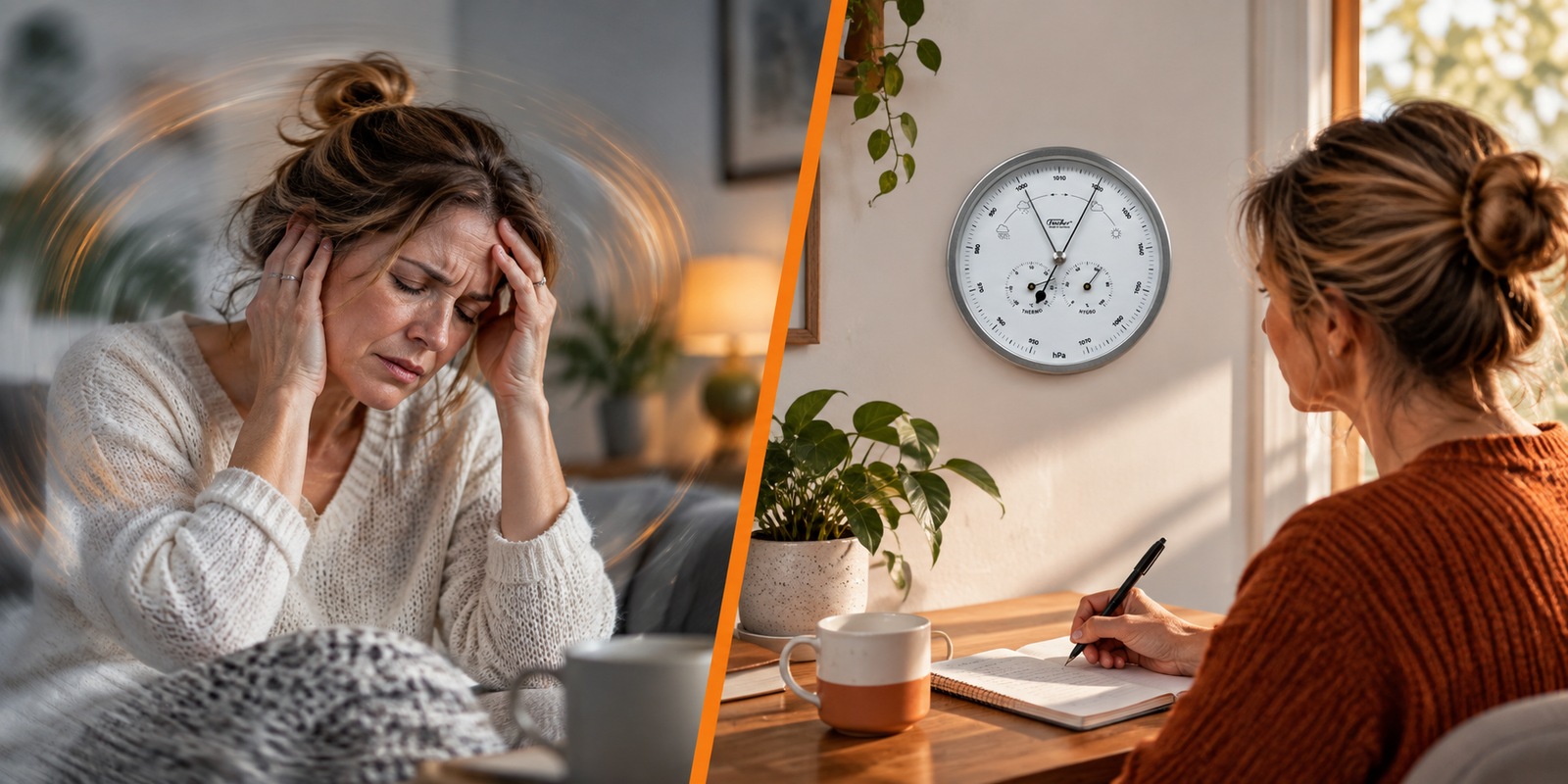
Some people report headaches or migraines when weather conditions and atmospheric pressure change.
Research into this is still developing. A systematic review of migraine studies found that some research has identified associations between pressure drops or rapid pressure changes and increased migraine frequency, while other studies found little or no association.
So there may be an effect for some weather-sensitive people, but there is no single pressure reading that can reliably predict symptoms for everyone.
If you suspect weather changes affect you, tracking symptoms alongside your local pressure trend may help you identify a personal pattern. A barometer should not, of course, be used to diagnose or treat a medical condition.
You can read the 2025 systematic review on barometric pressure and migraine here.
A Barometer Is Really About Watching Change
And this is the bit worth remembering.
People often ask:
What should the barometric pressure be?
But that is not really the most useful question.
A better question is:
What is the barometric pressure doing?
Is it rising?
Falling?
Dropping rapidly?
Barely moving?
That is where a barometer stops being a decorative dial on the wall and becomes a genuinely useful weather instrument.
Once you begin watching the pressure trend alongside the sky outside, forecasts on your phone and the weather that eventually arrives, you start understanding your local weather rather than simply being told about it.
And that is considerably more interesting.
Ready to Read the Weather for Yourself?
Explore our range of precision barometers and weather stations, including German-made instruments from Fischer. Built to measure the weather properly and designed to stay on the wall for rather longer than your next phone.
Frequently Asked Questions About Barometric Pressure
What is barometric pressure in simple terms?
Barometric pressure is the pressure created by the weight of the atmosphere around us. It is also called atmospheric pressure or air pressure and is measured with a barometer.
What does barometric pressure tell you?
Barometric pressure helps show how weather conditions are changing. Rising pressure commonly suggests conditions are becoming more settled, while falling pressure can indicate more unsettled weather is approaching.
What device is used to measure barometric pressure?
A barometer is used to measure barometric pressure. Most traditional home barometers are aneroid barometers, which use a flexible sealed metal capsule that reacts to changes in atmospheric pressure.
How is barometric pressure measured?
In Australia and New Zealand, barometric pressure is normally measured in hectopascals (hPa). Millibars (mb) are also commonly used, and 1 hPa is numerically equal to 1 mb.
What is normal barometric pressure?
Standard atmospheric pressure at sea level is 1013.25 hPa. Actual atmospheric pressure naturally varies above and below this figure as weather systems change.
What is considered high barometric pressure?
There is no single number that always defines high barometric pressure. A high-pressure system is an area where atmospheric pressure is higher than the surrounding region.
What is considered low barometric pressure?
Low pressure is pressure that is lower than the surrounding atmosphere. Low-pressure systems are commonly associated with cloud, rain, wind and more unsettled weather.
What does rising barometric pressure mean?
Rising barometric pressure generally indicates that conditions are becoming more stable or that a higher-pressure weather system is approaching.
What does falling barometric pressure mean?
Falling barometric pressure usually indicates that atmospheric conditions are becoming less stable and a low-pressure system or other weather change may be approaching.
How can I tell if barometric pressure is rising or falling?
Use the marker pointer on an analogue barometer to mark the current reading. Check the barometer again a few hours later. If the pressure needle has moved above the marker, pressure has risen. If it has moved below it, pressure has fallen.
At what barometric pressure does it rain?
There is no exact pressure reading that automatically causes rain. Rain depends on moisture, temperature, atmospheric lift and the wider weather system. Falling or lower pressure is commonly associated with wetter conditions, but the pressure trend is more useful than a single number.
What is the barometric pressure today?
Today's barometric pressure depends on your location. Check your nearest Bureau of Meteorology observation for the current local sea-level pressure, then compare it with your home barometer to see whether pressure is rising or falling.
How do I measure barometric pressure at home?
Use a properly calibrated home barometer. Once it has been set for your location, it will respond automatically as atmospheric pressure changes, allowing you to track rising and falling pressure throughout the day.



Leave a comment (all fields required)